
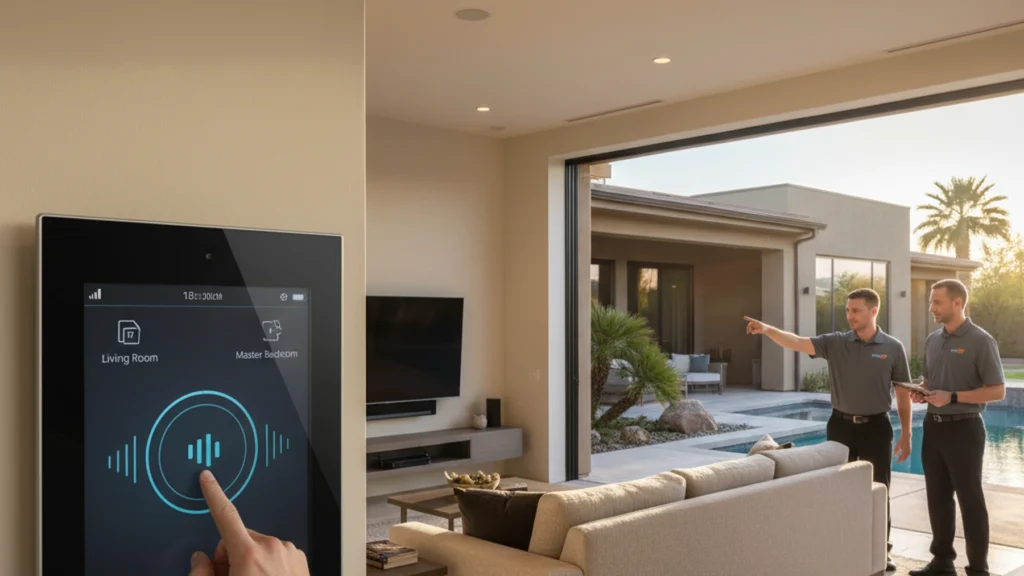
A whole home audio system lets you play music in any room, zone, or throughout your entire house, all managed from a single app or smart home interface. For Phoenix homeowners, multi-room audio video installation combines distributed speakers, streaming sources, and centralized control into one seamless experience, whether you want background music on the patio or immersive sound in every room simultaneously.
What Is a Multi-Room Audio System?
Multi-room audio refers to a network of speakers distributed throughout your home, each capable of playing the same audio source or independent streams in different zones. These systems rely on a combination of amplifiers, in-ceiling or in-wall speakers, wired or wireless connectivity, and a central control interface.
Modern whole home audio systems support streaming services like Spotify, Apple Music, and Tidal alongside local media libraries. The smart home integration layer connects audio playback to lighting scenes, thermostat schedules, and security systems, so your entire living environment responds to a single command.
Core components of a multi-room audio setup:
- Source devices (streaming players, turntables, cable boxes)
- Distributed amplifier or AV receiver
- In-ceiling, in-wall, or surface-mount speakers
- Wiring infrastructure (in new builds) or wireless bridging (in retrofits)
- Control app or dedicated touchscreen interface
- Optional: smart home hub for automation integration
Sonos Installation in Phoenix: A Popular Platform Choice
Sonos is one of the most widely deployed platforms for residential multi-room audio, and for good reason. Its app-based control is intuitive, the speaker ecosystem is broad, and it integrates cleanly with most home control platforms including Control4, Crestron, and Lutron.
For a Sonos installation in Phoenix, a certified AV installer will typically begin with a site survey to assess your home's wireless coverage, existing wiring, and room layout. Phoenix homes with open floor plans and high ceilings present specific acoustic challenges: sound disperses quickly and reflective surfaces can create unwanted echo. Proper speaker placement and tuning make a significant difference in the final listening experience.
What a Sonos installation typically includes:
- Wireless access point mapping to ensure strong signal in every room
- Speaker selection based on room size and ceiling height
- In-ceiling Sonos Architectural speakers paired with Amp units for powered zones
- App configuration, grouping presets, and music service linking
- Voice control setup via Amazon Alexa or Google Assistant
Sonos is not the only option. Systems like Savant, Bluesound, and Denon HEOS each offer distinct advantages depending on your existing media equipment, budget, and smart home platform. An experienced installer will recommend the right platform for your situation rather than defaulting to a one-size-fits-all solution.
Designing Your Whole Home Audio System

Good design starts before a single wire is run or speaker is mounted. The planning phase determines how many zones you need, which rooms get independent control, where amplifiers are located, and how the system integrates with your broader smart home.
Zoning: How Many Rooms Need Audio?
Each room or outdoor space that can be controlled independently is called a zone. A typical Phoenix home audio installation might include:
- Main living area
- Kitchen
- Primary bedroom
- Home office
- Covered patio or pool area
More zones mean more flexibility, but also more equipment and installation complexity. A skilled designer will balance your listening habits against realistic budget and infrastructure constraints.
Wired vs. Wireless: Which Is Better?
Both approaches work well when properly executed. The right choice depends on your home's construction and your goals.
Wired systems use in-wall speaker wire run from a central amplifier to each speaker location. They offer the most reliable signal, the lowest latency, and cleaner aesthetics since there are no visible components in each room. New construction or major renovations are the ideal time to run wired infrastructure.
Wireless systems like Sonos use your home's Wi-Fi network to stream audio to powered speaker units. They are faster to install, require no in-wall wiring, and are the practical choice for most retrofit projects. Signal quality depends on network strength, so a proper wireless site survey is part of every good installation.
Hybrid systems combine wired speaker runs from a centralized amp with wireless streaming sources. This is common in high-end installs where in-ceiling speakers are already wired but the homeowner wants the convenience of app-based control.
Speaker Selection
Speaker choice affects both sound quality and how the system looks in your home. Common options include:
- In-ceiling speakers: Most popular for whole home audio. Flush-mounted, painted to match the ceiling. Works in living rooms, bedrooms, kitchens, and hallways.
- In-wall speakers: Similar to in-ceiling but mounted vertically. Common for home theaters and dedicated listening rooms. Pairs well with home theater installations.
- Surface-mount speakers: No cutting required. Used in covered patios, garages, and spaces where in-ceiling mounting is not possible.
- Outdoor speakers: Weather-resistant enclosures rated for UV and moisture. Essential for outdoor entertainment areas in Phoenix, where patio living is year-round.
Smart Home Integration: Bringing It All Together
Multi-room audio becomes significantly more powerful when integrated with your smart home ecosystem. Rather than launching a separate app for every system, a unified control platform puts music, lighting, climate, and security under one interface.
Common integration scenarios in Phoenix smart home installs:
- Morning scene: Lights gradually brighten, thermostat adjusts to daytime setting, and soft music starts in the kitchen, all triggered by a single "Good Morning" command.
- Party mode: Every indoor speaker and the patio zone play the same playlist at a set volume level.
- Goodnight routine: All audio zones power off, exterior lights activate, and the security system arms.
- Video integration: When the TV in the living room turns on, that zone's speakers hand off to the home theater system automatically.
Platforms like Control4 and Crestron provide the deepest integration between audio, video, lighting, and climate systems. For simpler smart home setups, Sonos works natively with Apple HomeKit, Amazon Alexa, and Google Home without a dedicated control processor.
Installation: What to Expect From Start to Finish
Understanding the installation process helps set realistic expectations for scope, timeline, and disruption.
Phase 1: Design and site assessment. The installer visits your home, maps speaker locations, checks wireless coverage or wiring routes, and documents equipment placement (amplifier rack, control processor location, etc.).
Phase 2: Rough-in. In new construction, speaker wire, conduit, and low-voltage brackets are installed before drywall closes. In retrofits, installers use fishing techniques to run wire through finished walls with minimal patching required.
Phase 3: Equipment installation. Amplifiers, streaming players, and network hardware are rack-mounted or placed in a centralized location. Speakers are mounted and connected.
Phase 4: Programming and calibration. The system is programmed: zones are named, presets are set, integrations are linked, and audio levels are calibrated for each room. This phase is where experience matters most, as a poorly calibrated system will sound flat or uneven regardless of equipment quality.
Phase 5: Walkthrough and training. Your installer walks you through daily operation, app setup, and basic troubleshooting. A good AV company provides documentation and ongoing support.
Why Work With a Local Phoenix AV Installer?
Phoenix homes have specific environmental and architectural considerations that affect audio system design. High ambient temperatures affect equipment placed in attics or unconditioned spaces, requiring attention to ventilation and heat ratings. Open-concept layouts common in desert modern architecture require different speaker layouts than traditional segmented floor plans.
A local installer understands these nuances and can provide on-site support when you need adjustments, firmware updates, or system expansions. Remote support from a national retailer is not a substitute for a technician who knows your system and can be at your home the same day.
Working with a certified installer also means the equipment is properly registered, warranted, and configured to manufacturer specifications, protecting your investment over time.
Frequently Asked Questions
How many speakers do I need for a whole home audio system?
The number depends on your home's square footage, layout, and how many independent listening zones you want. A 2,000 square foot home typically needs 2 speakers per room, one stereo pair per zone, for balanced coverage. An AV designer will calculate exact quantities based on ceiling height, room shape, and your listening preferences.
Can I add multi-room audio to an existing home without tearing up walls?
Yes. Wireless platforms like Sonos and Bluesound are specifically designed for retrofit installs. Powered wireless speakers are placed in each room and connected to your home's Wi-Fi network. No in-wall wiring is needed, though a network assessment is still recommended to confirm signal coverage throughout the home.
What is the difference between a multi-room audio system and a home theater?
A multi-room audio system distributes music across many zones throughout the home. A home theater focuses on delivering cinematic sound for video content in a dedicated room or media space. The two can be integrated, so your home theater speakers become one zone in a whole-home audio system. Many clients combine both as part of a broader smart home installation.
How does Sonos compare to other multi-room audio platforms?
Sonos excels in ease of use, app quality, and wireless reliability for residential installs. Competing platforms like Savant offer deeper custom programming and more robust commercial-grade features. Bluesound is preferred by audiophiles for its high-resolution audio support. The best platform depends on your existing smart home infrastructure, media sources, and how much custom programming your setup requires.
Can outdoor speakers handle the Phoenix heat?
Outdoor-rated speakers designed for sun and heat exposure are standard for Phoenix installations. Look for speakers rated for operating temperatures above 140 degrees Fahrenheit and UV-resistant enclosures. Proper placement, avoiding direct prolonged sun exposure where possible, also extends speaker life. An experienced local installer will specify equipment appropriate for Arizona's climate.
Ready to Design Your Multi-Room Audio System?
Whether you're starting from scratch in a new build or upgrading an existing home, Amp AV designs and installs whole home audio systems built for the way Phoenix families actually live. From Sonos installations to fully integrated smart home audio setups, we handle the design, installation, calibration, and ongoing support.
Contact us to schedule a site assessment and get a system design tailored to your home.
Published by Amp AV Team | AV Installation Experts. Amp AV is a Phoenix-based audio video installation company specializing in multi-room audio, home theater, smart home control, and outdoor entertainment systems.