
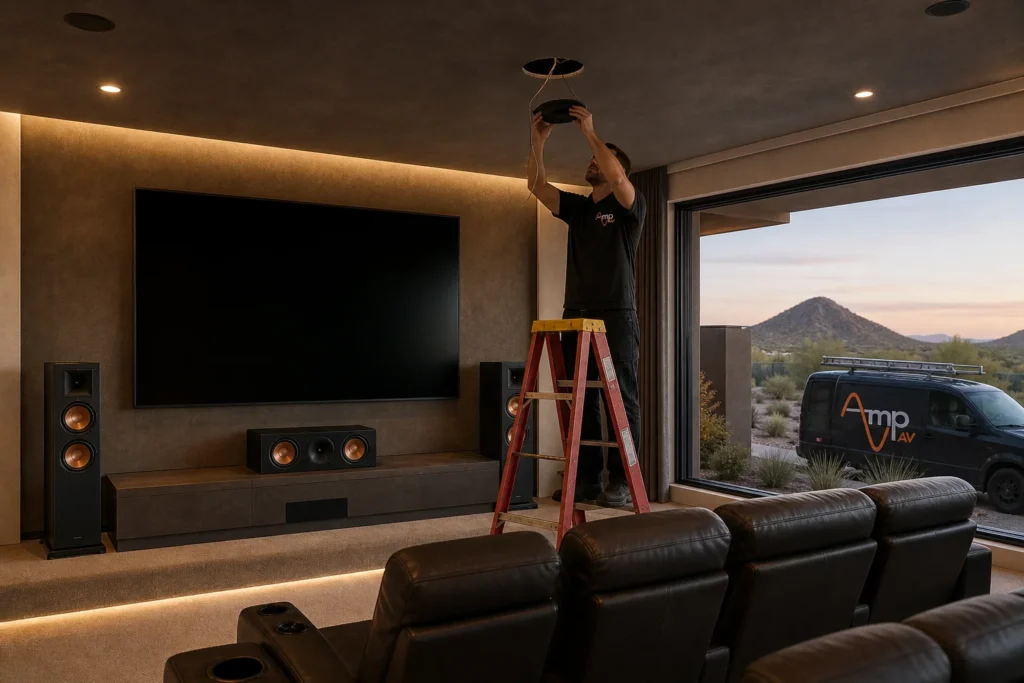
Dolby Atmos installation transforms a standard home theater into an immersive listening experience where sound moves overhead and around you, not just left to right. Phoenix homeowners investing in Home Theater Installations increasingly ask for Atmos as the standard, not the upgrade.
By Amp AV Team, AV Installation Experts
What Dolby Atmos Adds to a Home Theater
Dolby Atmos is an object based audio format that adds a height layer to traditional surround sound. Instead of locking sound effects to a fixed channel, Atmos treats each sound, rain, a passing helicopter, dialogue, as an object that can be placed anywhere in three dimensional space, including directly above your seating area. That height information is what separates a Dolby Atmos home theater from a conventional setup: rain falls from the ceiling instead of just the side walls, and footsteps on a staircase actually sound like they are moving upward.
For a media room or dedicated theater, this matters because most film and streaming content is now mixed with Atmos as the reference format. A room built for surround sound alone is already behind what current content expects. Adding the format properly means planning speaker setup around height channels from the start rather than bolting them on later.
How a Dolby Atmos Speaker Setup Works
A Dolby Atmos speaker setup builds on the same foundation as conventional surround sound, then adds overhead channels on top. The core layers are:
Left Right and Center Channels
Your front left right speakers and center channel carry dialogue, music, and the bulk of on screen action. These anchor the entire mix and need to be matched in timbre so voices sound consistent as they pan across the front stage.
Surround Speakers
Surround speakers, placed to the side and rear of the seating area, handle ambient effects and rear channel action. In a proper 5.1 or 7.1 base layer, these speakers create the horizontal ring of sound that surrounds the listener before any height information is added.
Overhead Speakers
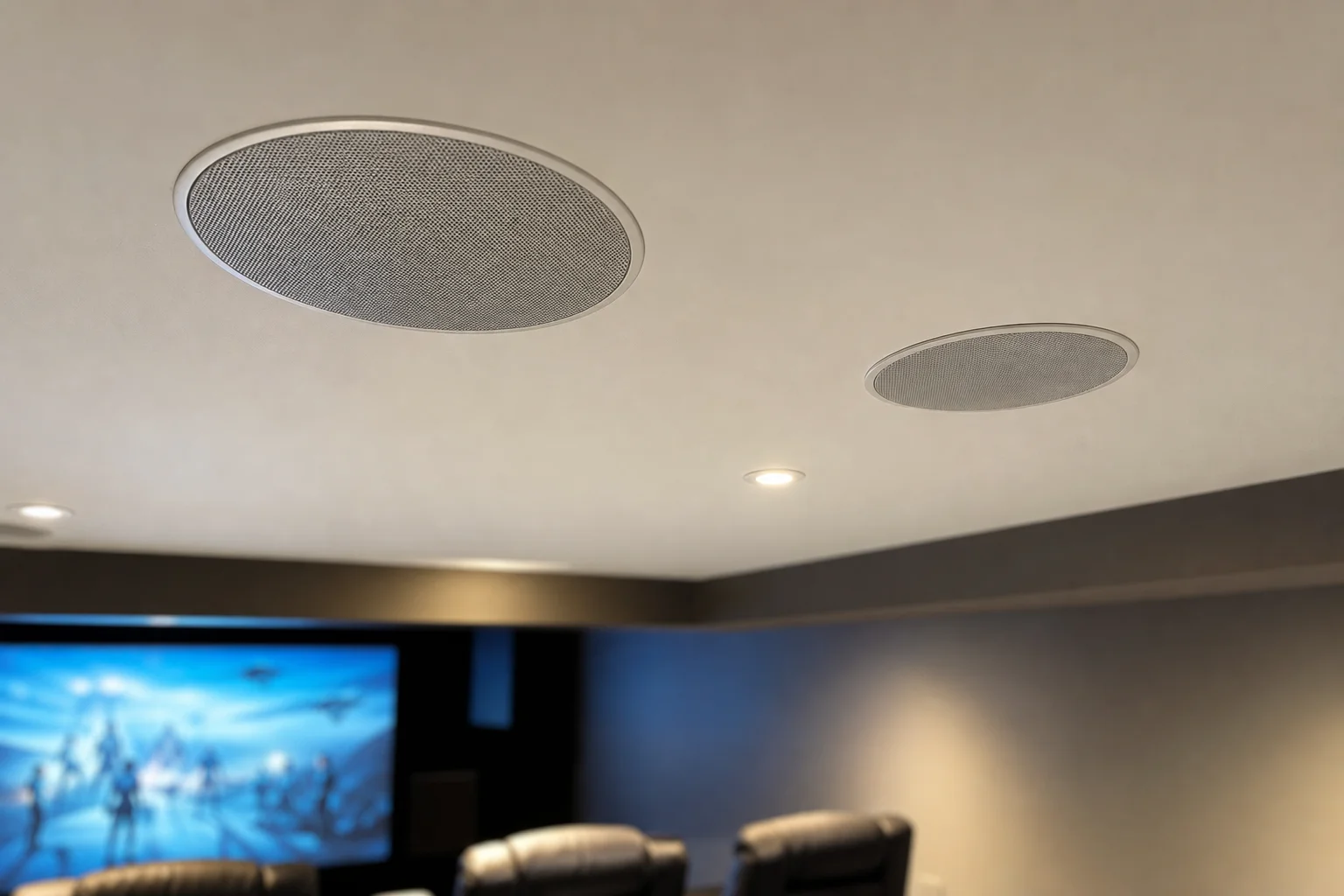
Overhead speakers, either in ceiling models or upward firing modules mounted on top of front and rear speakers, deliver the Atmos height channels. Two overhead speakers create a basic Atmos home theater configuration; four overhead speakers give a wider, more precise overhead field for larger rooms.
Subwoofer
A subwoofer or dedicated bass module rounds out the low end, giving weight to explosions, scores, and effects without straining the smaller satellite speakers.
Planning Your Room Layout Before Installation
Layout comes before any speakers, this is the step homeowners skip most often. A technician measures ceiling height, seating distance, and wall material to determine whether in ceiling overhead speakers or upfiring modules will perform better. Rooms with tall, sloped ceilings or exposed beams often need upfiring modules angled to bounce sound down at the correct reflection point. Large windows can also change how a room reflects sound, so acoustic treatment or heavier drapery is sometimes recommended alongside the speaker plan.
Getting the layout right the first time avoids drywall repairs later. For homeowners planning a full build rather than a retrofit, our Multi-Room Audio Video service can extend that same Atmos capable wiring plan to adjacent rooms so a media room upgrade does not require tearing into walls twice.
The Professional Installation Process
A professional Dolby Atmos installation typically follows four stages: room assessment, wiring and speaker placement, receiver and processor configuration, and calibration. During calibration, a technician uses a measurement microphone to check timing, level, and frequency response at the primary seating position, then adjusts each channel so the overhead speakers blend smoothly with the surround speakers instead of sounding separate from the rest of the mix. This is also when support for object based formats gets confirmed in the receiver firmware, since older units sometimes need an update before Atmos decoding works correctly.
Homeowners who want a broader technology overhaul at the same time can often route audio, lighting, and control system wiring through the same low voltage runs used for the Atmos installation. Planning that overlap up front, rather than adding it later, means the walls only need to be opened once.
Choosing the Right Configuration for Your Space
Not every room needs the same speaker count. A 5.1.2 configuration, five surround speakers, one subwoofer, two overhead speakers, works well for a family room or open concept living space where full acoustic treatment is not practical. A 7.1.4 configuration adds two more surround speakers and two more overhead speakers, and is better suited to a dedicated theater room with controlled lighting and seating rows.
Room shape and existing furniture layout also factor in. A long, narrow room favors a different surround speaker placement than a square media room, and ceiling height determines whether four overhead speakers can be spaced far enough apart to create real separation. For homes already building out a dedicated space, layout, seating, and acoustic material choices need to come together before speakers ever go in, and our luxury media room design guide covers that process in more depth. Homeowners extending sound beyond one room can plan how a theater zone connects to patio or kitchen audio without competing for the same amplifier channels, a topic covered further in our multi-room audio systems guide.
A theater build is also a natural point to plan ambiance for the rest of the house. Many clients pair their Atmos project with smart lighting control so dimming scenes and movie mode activate together at the press of one button.
Frequently Asked Questions
Do I need a full 7.1.4 setup to get Dolby Atmos?
No. A 5.1.2 configuration with two overhead speakers delivers genuine height effects and works well in most family rooms. Larger dedicated theaters benefit from 7.1.4 or higher, but the format scales down cleanly, so a smaller room still gets real Atmos performance without the full speaker count.
Can overhead speakers be added without ceiling access?
Yes. Upward firing modules sit on top of or near your front and surround speakers and bounce sound off the ceiling to simulate height channels. They are a strong option in rooms where running new ceiling wiring is not practical, though in ceiling speakers generally deliver more precise imaging when access allows.
Will my current receiver support Dolby Atmos?
Many receivers from the last several years support Atmos decoding, but not all handle the full channel count or object based processing without a firmware update. A technician can confirm compatibility during the room assessment before any wiring work begins.
How long does a typical installation take?
A standard 5.1.2 or 7.1.4 installation in an existing room usually takes one to two days, including wiring, mounting, and calibration. Projects that involve ceiling work, new construction wiring, or a full media room build take longer and are scheduled around the rest of the project timeline.
Does furniture placement affect the Atmos experience?
Yes. Seating position relative to the overhead speakers changes how well height effects localize. A calibration pass accounts for your actual seating layout, but moving a sofa significantly after installation can shift the sweet spot enough to warrant a quick recheck.
Start Your Dolby Atmos Installation with Amp AV
A properly planned Dolby Atmos installation turns everyday viewing into a genuinely immersive experience, and getting the speaker setup and layout right the first time saves both money and drywall. Reach out through Our Services to schedule a room assessment for your Phoenix home theater.