
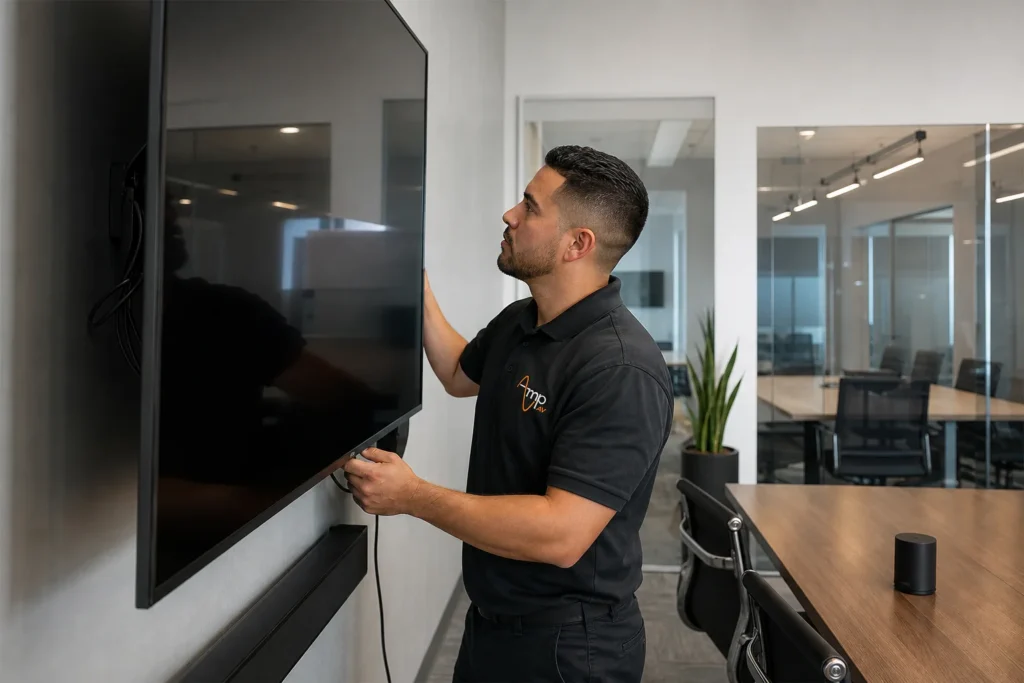
Commercial AV pricing in Mesa and Chandler swings widely because a huddle room and an auditorium need entirely different equipment. This guide breaks down what commercial AV costs for a Mesa or Chandler business, by room type, so you know which line items drive your bill before you request a quote through Our Services.
By Amp AV Team, AV Installation Experts
Conference rooms across Mesa and Chandler vary widely in size and use, which is exactly why per-room pricing works better than one flat number for the whole building.
Conference Rooms
A standard conference room is the baseline most Mesa and Chandler businesses use to compare quotes. The core package usually includes a display or two, a video conferencing camera, ceiling or table microphones, and a basic audio system tied into a simple control interface. Because conference rooms follow a repeatable template, integrators can often quote them faster and tighter than any other space in the building.
Boardrooms and Executive Meeting Spaces
A boardroom carries roughly double the line item count of a standard conference room. Expect a larger display or dual displays, a higher end camera with auto framing, a multi microphone array tuned for a long table, and often a dedicated control processor so an assistant can start a call with one tap. The finish matters here too: in ceiling speakers and hidden cabling take more labor than a room where cable can run along a baseboard.
Huddle Rooms and Small Meeting Spaces
Huddle rooms sit at the opposite end. A single display, one wide angle camera and speaker bar, and a simple wireless presentation puck cover most needs, which keeps the equipment total well under a full conference room package. The savings come from fewer components, not lower quality ones, and a business with an in-house IT team can often self-install a room this simple.
Training Rooms and Multipurpose Spaces
Training and multipurpose rooms add cost through flexibility. Movable furniture, multiple camera angles to cover a larger floor plan, a stronger audio system to reach the back row, and often a second display for overflow seating all push the total up. If the room doubles as an event space, budget for a portable or rack mounted mixer too.
Large Conference Rooms and Auditoriums
A large conference room or auditorium is the most expensive room type per square foot to wire correctly, driven by distributed audio zones, professional grade projection or a video wall, and a control system built for someone other than regular staff to run confidently. This is also the room type most likely to need a dedicated Multi-Room Audio Video approach, where audio is zoned and leveled separately from the front of room system so every seat hears the same mix.
What Factors Make Commercial AV Pricing Go Up or Down in Mesa and Chandler?
Room type sets the baseline, but several factors move the number from there. Building age and construction matter: an older building with finished ceilings and no existing conduit means more labor to run cable invisibly, while a new build or a space still under construction lets an integrator rough in wiring before drywall goes up, which is the cheapest time to do it. The type of business also plays a role: a law firm's boardroom and a medical office's conference room have different acoustic and privacy needs even at similar square footage.
Unlike a home theater installation, a commercial system has to perform reliably for people who did not choose the technology and were not trained on it, which is part of why professional installation earns its cost in a business setting. A commercial AV buildout that shares a network with the rest of the office IT setup usually costs less to integrate than one that needs its own isolated network, though it shifts more coordination onto whoever manages the building's network.
If your business leases its space, loop in your property manager or commercial real estate broker early, since some buildings restrict where conduit can run or require the building superintendent to approve after hours access for installation. Businesses that own their building and land have more flexibility to route cable exactly where they want it, which can lower labor cost even if it means a longer install. Square footage and ceiling height factor in too: taller ceilings need longer mounts and sometimes lift rental, and open floor plans with sound bleeding between zones need acoustic treatment that a closed conference room does not. Finally, the industry a business operates in can add requirements: a school or training center often needs simpler, more durable controls than a corporate office, while a business built around client facing presentations may prioritize display quality over audio spend.
Buying AV Equipment Outright vs. Bundling It With Local Installation
Some businesses ask about buying displays, cameras, and audio system components directly from a retailer and hiring an installer only for labor. It is possible, but it usually costs more in the end, not less. A bundled quote from a local integrator typically includes manufacturer relationships that lower equipment cost, a single point of accountability if something fails, and calibration and programming that a retail purchase does not include at all. Equipment bought outright can also void manufacturer warranties on commercial grade gear if it is not installed and registered by a certified dealer. The trade-off works the other way for a very small huddle room, where a simple all in one bar and a television are close enough to consumer grade that self-installation is realistic.
How Commercial AV Installation Cost Scales Per Square Foot
Per square foot thinking works for budgeting but breaks down as the only metric, because a small, densely equipped huddle room can cost more per square foot than a large, sparsely equipped open floor. What actually scales with square footage is cable run length, the number of speaker or camera zones needed to keep audio and video consistent across the room, and the structure of the ceiling or walls the crew has to work around. A single story office building with a drop ceiling is the least expensive structure to wire and the fastest installation process; a building with hard ceilings, a raised floor, or a historic structure that limits where holes can be cut raises labor cost regardless of square footage.
What's Typically Included in a Commercial AV System Quote
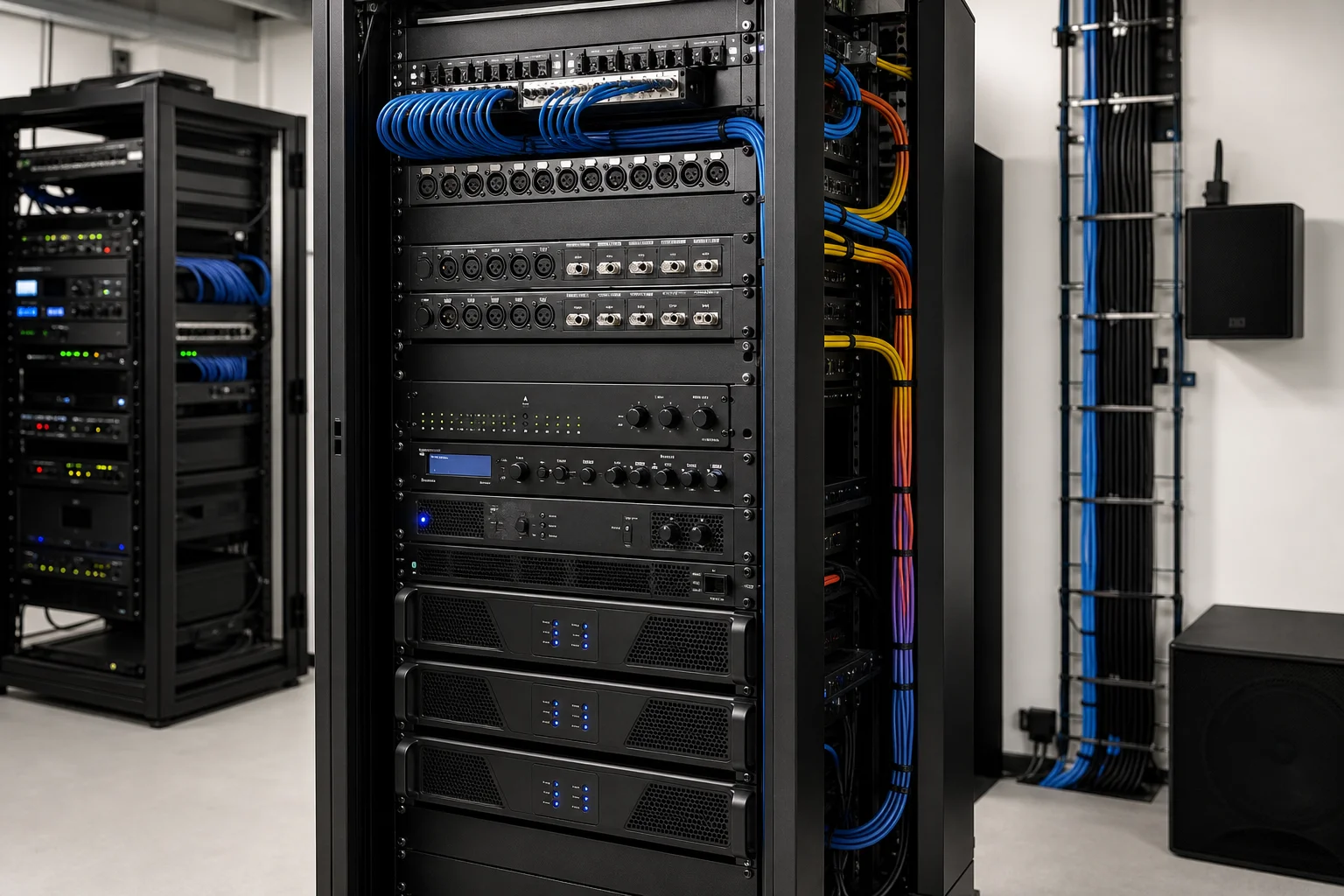
A complete quote should separate four categories so you can see where your money goes: equipment (displays, cameras, microphones, audio system components, and the control processor), labor (rough-in wiring, mounting, and rack build), programming (control interface setup and any integration with room scheduling or building automation), and ongoing services (a service plan or extended warranty). Commercial AV cost by room type is the clearest way to think about your budget line by line, since it lets you compare what one conference room needs against what a training room needs without averaging them into a meaningless blended number.
Ask any integrator to itemize these four categories separately. A quote that only shows one lump total makes it harder to select the right options or compare against a second bid.
Frequently Asked Questions
How long does commercial AV installation take for a Mesa or Chandler office?
A single conference room typically takes one to two days once equipment arrives. A full floor project with multiple room types, cable rough-in, and a central rack build usually runs one to three weeks depending on how many rooms are involved and whether the building stays occupied during the work. Older buildings with limited existing conduit generally add time to the schedule.
Do Mesa or Chandler businesses need permits for commercial AV installation?
Most in-wall audio and low voltage cabling work in commercial spaces does not require a separate permit, but anything touching the building's structure, such as new wall openings, ceiling modifications, or a dedicated electrical circuit for a large display or rack, may need a permit through the city. A local integrator familiar with Mesa and Chandler code can usually confirm before work starts.
What's the cost difference between DIY and professional commercial AV installation?
DIY can lower the upfront equipment number for a single huddle room, but it shifts programming, calibration, and troubleshooting onto internal staff, and it usually voids commercial warranty coverage on gear installed without a certified dealer. Professional installation costs more upfront and less over the life of the system for anything larger than one small room.
Does the type of business affect commercial AV cost?
Yes. A law office and a medical practice may need similar room sizes but different privacy and acoustic treatment. A retail business built around client presentations often prioritizes display quality, while a school or training center usually prioritizes durable, simple controls over premium finish. The room's job, not just its square footage, shapes the final quote.
What information does an integrator need to give an accurate quote?
Room dimensions and ceiling height, how many people typically use the space, whether the room needs video conferencing or presentation only, existing network infrastructure, and whether the building is occupied or under construction. Photos or a floor plan speed up the first estimate significantly, and a short walkthrough replaces guesswork with an exact number.
Get an Exact Commercial AV Quote for Your Mesa or Chandler Space
Now that you know what commercial AV costs for a Mesa or Chandler business, by room type, the fastest way to get an exact number is a short walkthrough of your space. Contact Us to schedule one.